
Why Optogenetics Won the 2026 Nobel Prize

For most of the history of neuroscience, researchers studying the living brain have been in the position of a mechanic who can listen to an engine but never touch it. Electrodes could record the chatter of neurons, scanners could show which regions lit up during a task, and drugs could flood whole systems with chemicals. What nobody could do was reach into a working brain, pick out one precisely defined type of cell, and flip it on or off with millisecond timing to see what happened. On Monday, 5 October 2026, the Nobel Assembly at Karolinska Institutet awarded the Nobel Prize in Physiology or Medicine to the three scientists whose work made that possible: Karl Deisseroth, 54, of Stanford University; Peter Hegemann, 71, of Humboldt University of Berlin; and Georg Nagel, 73, of the University of Würzburg. The three share 12 million Swedish kronor, about $1.2 million, for laying the foundations of optogenetics.
The committee did not hedge about the scale of the contribution. "Optogenetics provides opportunities for mapping the brain in a way that we could once only dream of," said Per Svenningsson, chair of the Nobel Committee. Thomas Perlmann, secretary-general of the Nobel Assembly, described a method that "makes it possible to switch on, or off, the activity of individual nerve cells in a living brain" and that is now used in laboratories worldwide.
From swimming algae to a molecular switch
The story begins not in a brain but in a pond. In the early 1990s, working at the Max Planck Institute, Hegemann was trying to understand how Chlamydomonas reinhardtii, a single-celled green alga, manages to swim toward light. The organism has a primitive eyespot, and Hegemann suspected the light sensing relied on a rhodopsin-like protein, a cousin of the pigment in our own retinas. Together with Nagel, a biophysicist with expertise in measuring the currents that flow through membrane proteins, he identified what they eventually named channelrhodopsin: a protein that is both a light sensor and an ion channel in one molecule. When a photon strikes it, the channel snaps open within milliseconds and lets positively charged ions rush into the cell.
That dual nature is what made the discovery extraordinary. Most light-sensing systems in biology work through long cascades of signalling molecules, which makes them slow and hard to transplant. Channelrhodopsin needed no helpers. In papers published in 2002 and 2003, Nagel, Hegemann and colleagues showed that the protein, and especially a variant called channelrhodopsin-2, could be expressed in cells that had nothing to do with algae, such as frog egg cells and human kidney cells, and still make them respond to blue light. Don Hilgemann, the University of Texas Southwestern biophysicist who mentored Nagel in the early 1990s, recalled that "Georg showed real pioneer spirit in applying the methods I had developed."
The obvious next question was whether the same trick would work in neurons, the cells that actually generate thought and behaviour. Several groups were circling the idea. In 2002, Gero Miesenböck had already demonstrated the first genetic method for making non-light-sensitive neurons respond to light, using a more complex multi-protein system. In 2004, Zhuo-Hua Pan at Wayne State University put channelrhodopsin into retinal ganglion cells and made them light-responsive, although his paper was not published until 2006. The Nobel committee's background material acknowledges both researchers.
The decisive step came from Deisseroth's newly opened lab at Stanford. In a 2005 paper in Nature Neuroscience, his team, with Ed Boyden as first author, showed that channelrhodopsin-2 could be expressed in mammalian neurons and that brief pulses of blue light would make those neurons fire with high temporal precision, spike for spike. "The key moment occurred when I put the algal gene into neurons," Deisseroth told Stanford. He has described it as "the approach with the highest risk," yet "it turned out to be the one that worked best." One crucial finding was that the mammalian brain already contains the retinal cofactor channelrhodopsin needs to function, which meant other labs could adopt the tool without adding chemicals. That simplicity explains why the method spread so fast.
Cause, not correlation
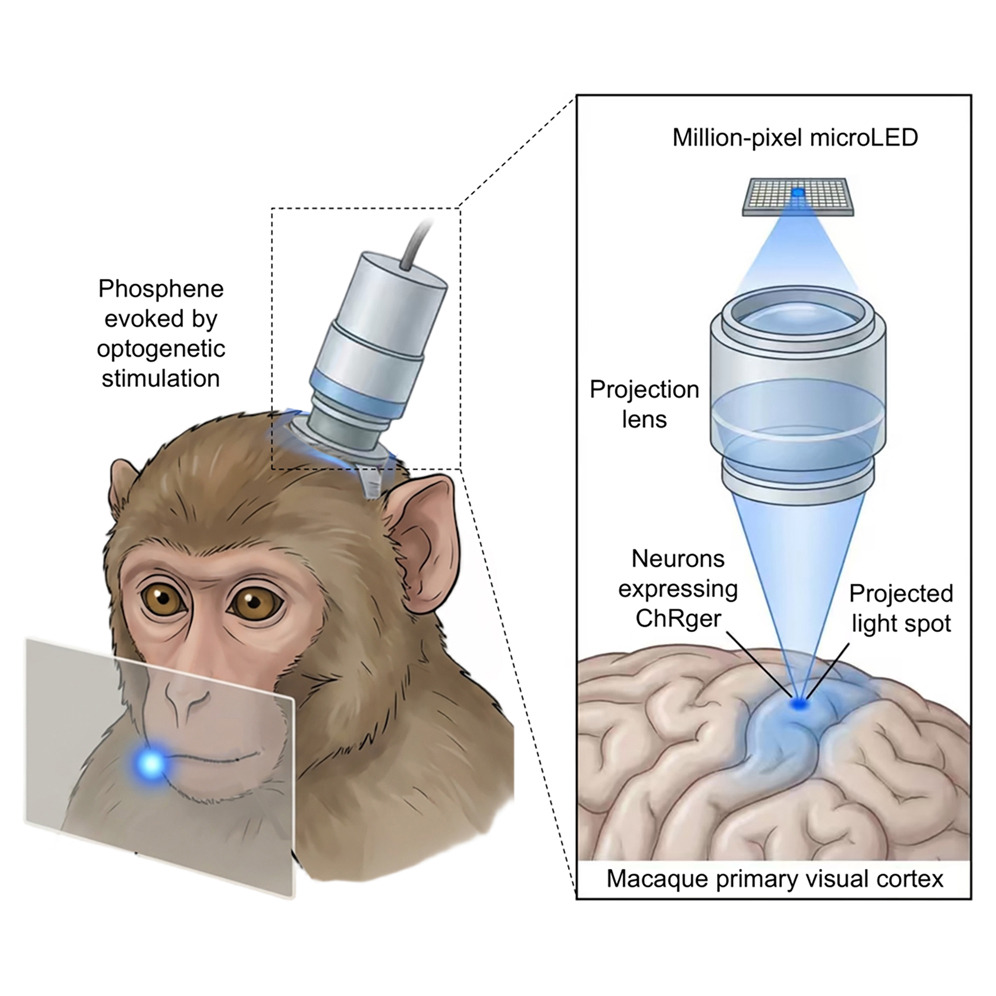
To understand why this matters, it helps to understand the central frustration of neuroscience. Brain imaging and electrical recordings are correlational: they show that certain neurons are active when an animal is afraid, or hungry, or making a decision. They cannot show that those neurons cause the fear or the hunger. Optogenetics broke that impasse. By combining channelrhodopsin with genetic targeting, researchers can make only one class of cells sensitive to light, for example dopamine-producing neurons or a particular population in the amygdala, and then deliver light through ultrathin optical fibres implanted in a freely moving animal.
"We're not using light to collect information, we're using light to cause things to happen," Deisseroth told reporters. In Stanford's account he put it even more compactly: "This is the key principle of optogenetics: precise causal perturbation."
The toolkit quickly grew beyond the original switch. Deisseroth's group and others engineered opsins that respond to yellow light and silence neurons rather than excite them, which let researchers turn circuits off as well as on. Variants tuned to different colours made it possible to control two cell populations independently in the same animal. Over two decades, optogenetics has been used to find specific circuits behind reward and addiction, anxiety, sleep, social behaviour, movement, memory formation and recall. In work with Anatol Kreitzer at UCSF, Deisseroth's team identified two pathways involved in Parkinson's disease and reversed movement symptoms in mice by manipulating them. Other experiments induced and then relieved depression-like behaviour in rodents, and pinpointed circuits governing social interaction and dissociation. Michelle Monje used optogenetics to show that some brain cancers depend on surrounding neural activity to grow, a finding that has opened a new field linking neuroscience and oncology.
It is worth being precise about what optogenetics is not, at least not yet: a mainstream human treatment. Because it requires introducing a foreign gene into target cells, usually with a viral vector, and then delivering light to them, almost all of its use so far has been in animal research. But the first clinical signals exist. In 2021, a team led by José-Alain Sahel reported in Nature Medicine that a man blinded by retinitis pigmentosa partially regained the ability to locate and count objects after his retinal cells were given a light-sensitive opsin and he wore goggles that converted the visual scene into pulses of amber light. Researchers are also pursuing optical cochlear implants, which could stimulate the auditory nerve far more precisely than today's electrical devices and potentially give deaf patients richer sound perception. Deisseroth, who still practises as a psychiatrist treating people with treatment-resistant depression and autism, frames the clinical value more broadly: once optogenetics reveals which cells drive a symptom, "then you can design any method" to target them, whether drugs, electrical stimulation or gene therapy.
The prize has not been free of argument. Nobel rules cap any award at three laureates, and on social media many scientists questioned the exclusion of Boyden, now at MIT, who was first author on the landmark 2005 paper. Others pointed to the contributions of Miesenböck and Pan. The committee chair declined to explain the choice. Disputes like this are common in fields built by overlapping teams, and they are a reminder that the Nobel is a snapshot of a collective effort rather than a full accounting of it. Deisseroth himself stressed that the trio "spans the progression from the early algal explorations" to the neuroscience applications, and said he "couldn't be happier than to share this with these two friends."
What makes the 2026 prize resonate beyond neuroscience is the path the discovery took. Nobody set out to build a brain-control tool by studying how pond algae swim. Hegemann and Nagel were doing curiosity-driven basic biology on an organism few people outside their field cared about, and the payoff arrived more than a decade later in a completely different discipline. When a National Institutes of Health reviewer assessed an early proposal to use the protein in the retina, they called it "quite an unprecedented, highly innovative proposal, bordering on the unknown." That is the territory the prize rewards, and it is a useful corrective at a time when research funding is often judged on how quickly it pays off.
Asked what comes next, Deisseroth's answer was characteristically short:
"Get back to work. We have a lot of things still to discover, and a lot of people to help."
Sources: Nobel Assembly at Karolinska Institutet announcement (5 October 2026); Stanford University; STAT News; Al Jazeera; Nagel et al., Science (2002) and PNAS (2003); Boyden et al., Nature Neuroscience (2005); Sahel et al., Nature Medicine (2021).
Cite this entry
Bug Crawler (2026). Why Optogenetics Won the 2026 Nobel Prize. Bug in Word. https://buginword.com/blog/why-optogenetics-won-the-2026-nobel-prize